Gate of the Sun
Back to all places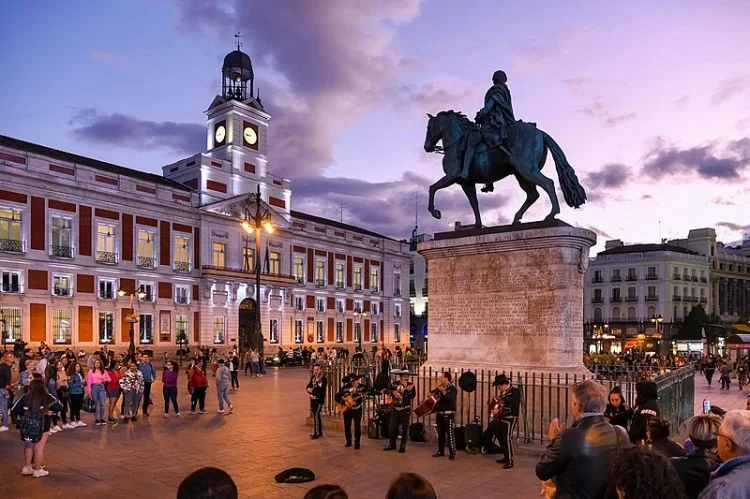
The Puerta del Sol (English: "Gate of the Sun") is a public square in Madrid, one of the best known and busiest places in the city. This is the centre of the radial network of Spanish roads. The square also contains the famous clock whose bells mark the traditional eating of the Twelve Grapes and the beginning of a new year. The New Year’s celebration has been broadcast live since 31 December 1962 on major radio and television networks including Atresmedia and RTVE.
The Puerta del Sol originated as one of the gates in the city wall that surrounded Madrid in the 15th century. Outside the wall, medieval suburbs began to grow around the Christian Wall of the 12th century. The name of the gate came from the rising sun which decorated the entry, since the gate was oriented to the east. Between the 17th and 19th centuries, the area was an important meeting place: as the goal for the couriers coming from abroad and other parts of Spain to the Post Office, it was visited by those eager for the latest news. The stairs to the Saint Philip church at the square were known as the Gradas de San Felipe, and were among the most prolific mentideros de la Corte (this Spanish idiom sounds as "lie-spreaders of the Court", but it is related with the verb mentar, "to say about someone", not mentir, "to lie", so it is more appropriately translated as "places of the City where people gossip").
The House of the Post Office was built by French architect Jacques Marquet between 1766 and 1768. The building was the headquarters of the Ministry of Interior and State Security in Francoist Spain. It is currently the seat of the Presidency of the Madrid Community. Sol has seen protests against the March 11th 2004 attacks on commuter trains, and Spain’s involvement in the Iraq War. In 2011, the square became established as a focal point and a symbol for the ongoing Spanish democracy demonstrations. The demonstrations included camping in the middle of the plaza, which began on 15 May 2011 amidst the election campaign for city halls and Autonomous Communities governments and which was fueled by social media, particularly Twitter and Facebook. The demonstrations then spread to more than sixty other cities throughout Spain. Since 12 June 2011, the square has held a free-standing domed structure made from pallets, which served as an information point for the 15-M Movement. This continued throughout the summer of 2011 until the dawn of 2 August, when the national police decided to evict the structure and protestors. Currently, dozens of committees have their assemblies in the iconic square.
Despite once being the meeting point of the six major radial roads of Spain, in 2020 the square was pedestrianized and closed to most traffic. Exceptions are made for supplies to shops, emergency services and blood donation campaigns.
https://en.wikipedia.org/wiki/Puerta\_del\_Sol
Photo: Jorge Franganillo
40.41695, -3.70353